
I use Alcotest and dune-release for almost every OCaml package I release: the first runs the tests, and the second publishes the result on opam. Both had collected issues and pull requests over the years (the oldest issue I closed this week dates from 2017), so I spent the past week going through them. Alcotest 1.10.0 and dune-release 2.3.0 are the result. For me, the most useful changes are that Alcotest can now write JUnit reports without any change to your tests, and that tests can carry tags. A tool that reads a folder of reports can tell a flaky test from a broken one, and a tag then puts the flaky test aside until it is fixed.
dune-release 2.3.0 is on opam, and Alcotest 1.10.0 is about to be. The opam-repository CI shows failures in packages that depend on it, which I want to triage properly first. Testing it before then is very welcome, with a pin:
$ opam update
$ opam install dune-release
$ opam pin add -n https://github.com/mirage/alcotest.git#1.10.0
$ opam install alcotest
Nested tests
Alcotest suites used to have exactly two levels. suite, test and
group now nest to any depth, and the existing test_case and tuples
keep working next to them. A group's name is joined to its suite's with a
dot, and a regular expression on that name selects what runs:
open Alcotest

let parse () = check int "parse" 42 (int_of_string "42")
let hex () = check int "hex" 255 (int_of_string "0xff")
let big () = check int "big" 1_000_000 (int_of_string "1000000")
let neg () = check int "neg" (-1) (int_of_string "-1")

let () =
  run "parser"
    [
      suite "int"
        [
          test "parse" parse;
          group "edge" [ test "big" big; test "neg" neg ];
          test "hex" hex;
        ];
    ]
$ ./test_parser.exe test '^int\.edge'
Testing `parser'.
This run has ID `M0FK86F8'.

  [SKIP]        int               0   parse.
  [OK]          int.edge          0   big.
  [OK]          int.edge          1   neg.
  [SKIP]        int               1   hex.

Full test results in `logs/M0FK86F8'.
Test Successful in 0.001s. 2 tests run.
Nesting was a long-standing request. Craig
Ferguson opened the
issue in 2020, and
followed it with an RFC
the next year: abstract test types nested to any depth, with tags and
source positions.
In the discussion, Etienne Millon called the
two-level limit Alcotest's biggest, and Martin
Jambon argued for a flat list with dotted
names instead. Yawar Amin later proposed
a suite function to make
tests shorter to write. The RFC stalled on its abstract types, which would
have broken every existing test suite. This release takes group from
Craig's RFC, suite and test from Yawar's proposal and the dotted names
from Martin, and adds them next to the existing types rather than in
place of them. The RFC's tags and source positions are in this release
too, in the sections below. Thanks to all of them.
Failures that point at your test
Every failure now starts with the file and line of the test, including
uncaught exceptions and failures inside helpers. Here is a test with a bug
(-0 does not survive a round trip):
let round_trip s =
  Alcotest.(check string) "round trip" s (string_of_int (int_of_string s))

let decimal () = List.iter round_trip [ "1"; "-1"; "-0" ]

let () =
  Alcotest.run "parser"
    [ ("int", [ Alcotest.test_case "decimal" `Quick decimal ]) ]
# 1.9.1
File "list.ml", line 114, character 12:
FAIL round trip
# 1.10.0
File "test_parser.ml", line 8, character 16:
FAIL round trip
(The idea and some of the code come from Daniel
Bünzli's B0_testing. A test case written as a
plain tuple can still lack a location, and wasm and js_of_ocaml builds do
not record backtraces, so they print none: this
issue tracks a fix.)
JUnit reports without touching your tests
GitLab,
CircleCI and
Jenkins all read test results as JUnit
XML. Other ecosystems differ in how much work this takes.
pytest,
Deno,
Bun and
Node.js have an option.
Go needs gotestsum, Jest
needs jest-junit, and Rust
needs nextest (cargo test only offers it on nightly).
In OCaml, junit_alcotest by
Louis Roché has written these reports for
Alcotest since 2017. Each test executable calls its run_and_report in
place of Alcotest.run, then writes the report to a path of its choice.
As a layer on top, it only sees what Alcotest's public interface gives it,
which has no source locations. Inside Alcotest, the report can take each
test's file and line from the same place as the failure messages above,
and it can still be written when a test ends the process early.
Alcotest now has --junit, and an environment variable, ALCOTEST_JUNIT,
that goes through dune. Existing tests and dune files need no change to
export JUnit reports. Each run adds its report to _build/_tests/junit:
$ ALCOTEST_JUNIT=1 dune test --force
$ ls _build/_tests/junit
parser-20261109-101751-ZGXMDTK7.xml
store-20261109-101749-K6LO6TC3.xml
# .gitlab-ci.yml
test:
  variables:
    ALCOTEST_JUNIT: "1"
  script:
    - dune test
  artifacts:
    when: always
    reports:
      junit: _build/_tests/junit/*.xml
Each failure carries its file and line, and the report survives a test
that ends the process. Here, write calls exit, as a library that gives
up might, and the report still names it:
open Alcotest

let read () = check string "read" "a" "a"
let write () = exit 3
let close () = ()

let () =
  run "store"
    [
      suite "kv"
        [ test "read" read; test "write" write; test "close" close ];
    ]
<testcase name="read" classname="store.kv" time="0.000"/>
<testcase name="write" classname="store.kv" time="0.000">
<error message="[crash] The process stopped while
this test was running." type="crash">
The reports are experimental, which is why they are off by default for now. I would like to hear from people who use them before deciding whether they should be on by default and which fields they are missing.
Flaky or broken?
Keeping one report per run gives a history that other tools can read. To
try it, I wrote a toy key-value store with two kinds of failure.
cache.lookup loses a race about one run in six (faked with Random,
since a real race does not fail on demand), and after twenty runs I
committed a refactoring of compact that forgets to drop deleted keys:
-  Hashtbl.filter_map_inplace (fun _ v -> Option.map Option.some v) t;
+  Hashtbl.filter_map_inplace (fun _ v -> Some v) t;
flakemap reads the whole history from that folder (I ran the first twenty runs before the refactoring and the last ten after it):
$ export ALCOTEST_JUNIT=1
$ for i in $(seq 30); do dune test --force; done
$ flakemap _build/_tests/junit --html flakemap.html
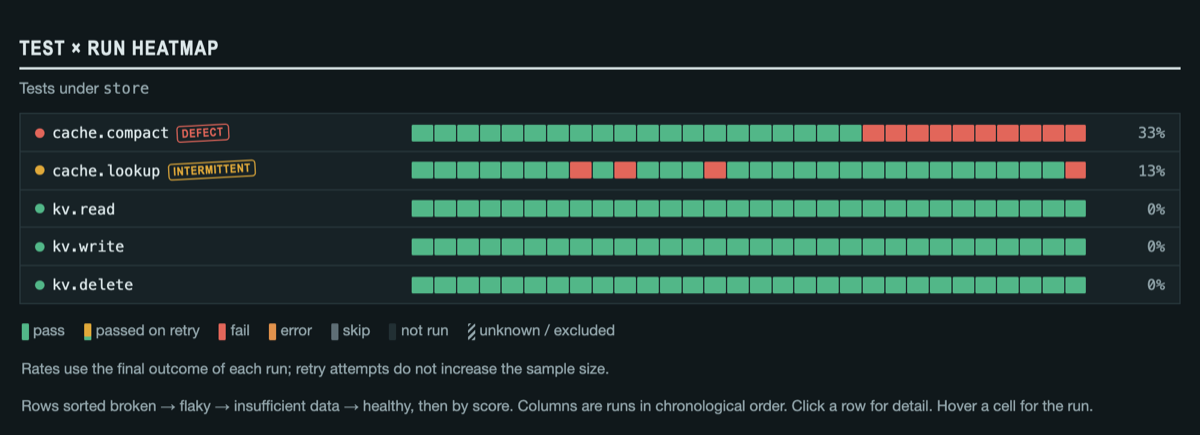
flakemap marks cache.compact as broken since the twenty-first run, the
first after the refactoring, and cache.lookup as flaky, failing in 13% of
the runs. Nothing was added to the reports for that: each file is a run,
and the test names inside are the rows. flakemap is very new (its
repository dates from September 2026) and orders the runs by the files'
modification times.
I picked flakemap because it was the first tool I found that draws a
history from local JUnit files, and others probably do more, or do it
better. junit2html, around since
2016, draws the same grid with --report-matrix, for instance. That is
the point of a common format, even if with JUnit each tool seems to change
the standard a little. Alcotest gives each failing test a file and a
line, as pytest's xunit1 reports do, and GitLab shows that file next
to the failure.
Putting a flaky test aside
Once a test is known to be flaky, I would rather skip it in normal runs
and keep running it somewhere else. Tests can now carry tags, and a run picks the tags
it wants with --tags or ALCOTEST_TAGS (a bit like Go's build tags). A
test tagged
`Tag "flaky" is skipped unless the run asks for it, so a nightly job
can keep an eye on it:
-  suite "cache" [ test "lookup" lookup; test "compact" compact ];
+  suite "cache" [ test ~tags:(`Tag "flaky") "lookup" lookup; test "compact" compact ];
$ dune test
  ...
  [SKIP]        cache          0   lookup.
  [OK]          cache          1   compact.

Test Successful in 0.003s. 4 tests run.
$ ALCOTEST_TAGS=flaky dune test --force
  ...
  [OK]          cache          0   lookup.
  [OK]          cache          1   compact.

Test Successful in 0.001s. 5 tests run.
The JUnit report keeps the skipped test as <skipped/>, and flakemap
leaves those runs out of lookup's rate rather than counting them as
passes, so a test put aside does not start to look healthy. The built-in
`Slow tag works the same way (-q stops those tests), and tags
combine, as in Tag.(slow && v "release").
The same tests under wasm
Alcotest now works with
wasm_of_ocaml, thanks to Hugo
Heuzard and Quentin
Hocquet.
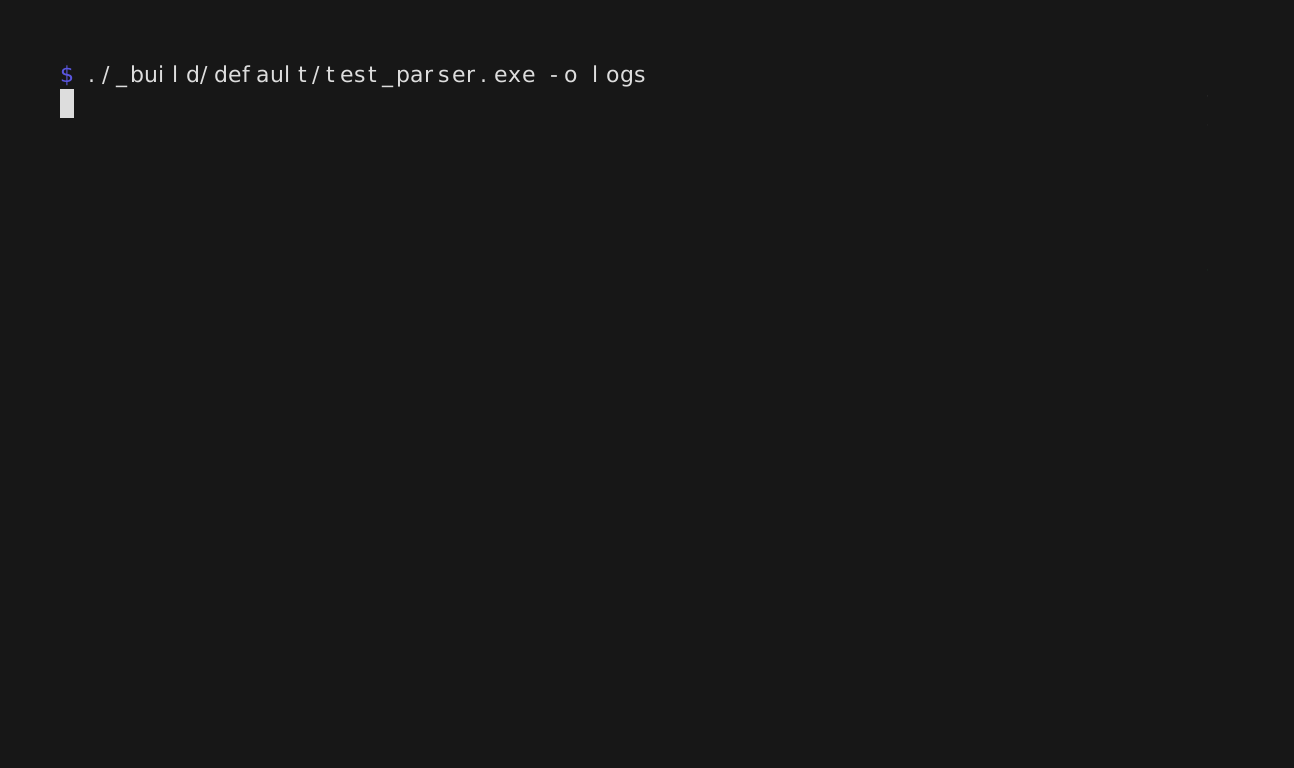
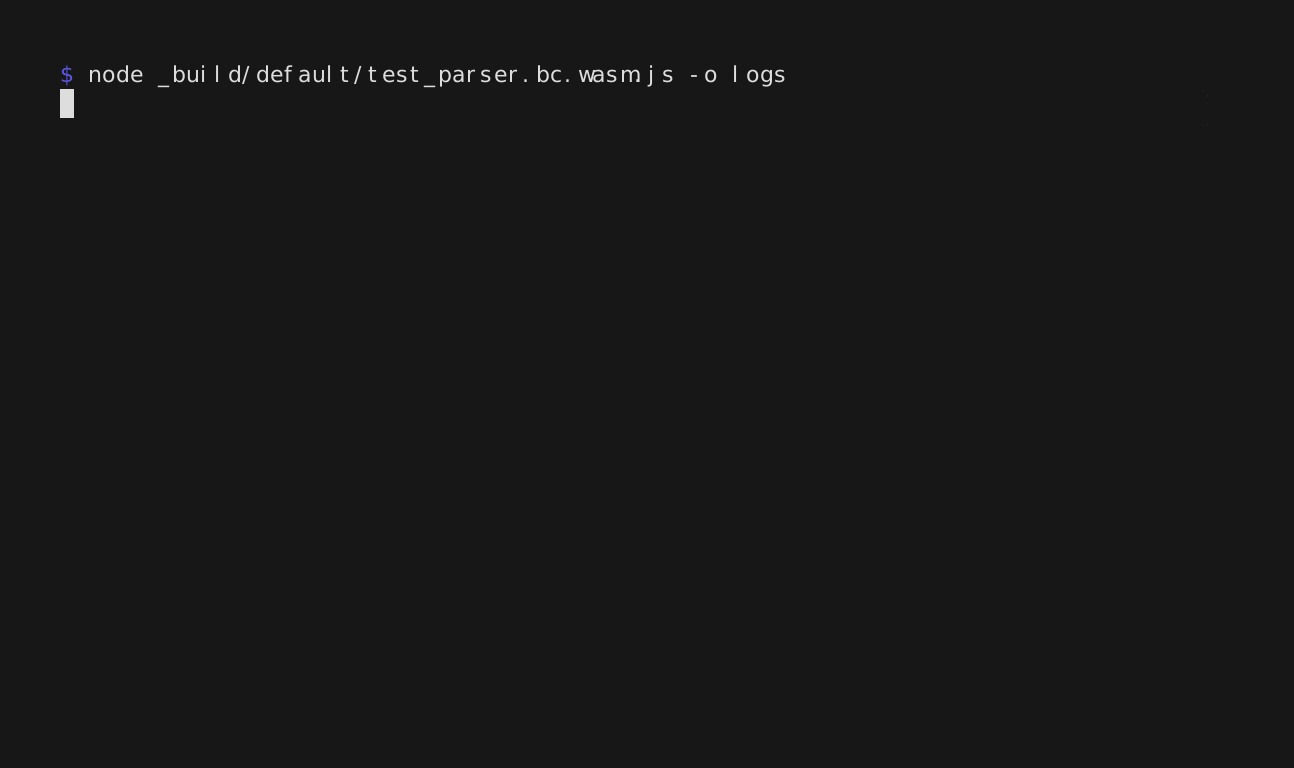
Add one mode to a dune stanza, and dune test runs the tests both ways
(you need wasm_of_ocaml-compiler, Binaryen and Node.js). This is worth
doing because int has 31 bits under wasm and 63 on a 64-bit native build,
and that is easy to forget:
(test
 (name test_parser)
 (modes exe wasm)
 (libraries alcotest))
open Alcotest

let gib n = n * 1024 * 1024 * 1024
let five_gib () = check string "5 GiB" "5368709120" (string_of_int (gib 5))
let () = run "sizes" [ suite "gib" [ test "five" five_gib ] ]
Upgrading Alcotest
A suite that only uses test_case and tuples should compile unchanged.
Alcotest now requires OCaml 4.14 and dune 3.17, and the empty alcotest-js
package is gone (depend on js_of_ocaml-compiler instead). speed_level
is now an alias of the new tag type, which has more cases than
`Quick and `Slow. Code that restates the old type as
[ `Quick | `Slow ] stops compiling, and a match that handles only
those two cases is no longer exhaustive. The new names test, suite and group can
also hide values of your own. The
changelog has
the rest, including UTF-8 in string failures and new testables for
Uchar.t and Iarray.t.
dune-release on Windows
dune-release distrib and dune-release check now work on Windows,
building on work that
Etienne Millon started in 2021, and
the test suite runs there too. publish and opam submit are only tested
there with --dry-run, and tar, bzip2 and curl must be in the PATH,
so reports from Windows users are very welcome.
The other change you will notice is from Josh
Berdine: files marked export-ignore in
.gitattributes no longer reach the release archive, as with git archive:
# .gitattributes
dune-workspace export-ignore
.github/** export-ignore
$ dune-release distrib
$ tar tjf _build/hello-0.1.0.tbz
hello-0.1.0/.gitattributes
hello-0.1.0/CHANGES.md
hello-0.1.0/LICENSE.md
hello-0.1.0/README.md
hello-0.1.0/dune-project
hello-0.1.0/hello.opam
dune-release also builds with the opam 2.6 libraries (thanks to Vincent
Laporte), publish respects --dev-repo (thanks
to Shon Feder), and opam submit always
prints the URL of the pull request it opened. Its
changelog
has the rest.
Thanks to everyone above and to the other contributors and reviewers named in the changelogs, some of whom waited for years. Feedback is welcome on the Alcotest and dune-release issue trackers. Before 1.10.0 reaches opam, I am most interested in Alcotest code that stopped compiling, and in how the JUnit reports fare in your CI. The new features are meant to be backward compatible, unless you write your own engine or rely on one of its internal types. Apart from the cases in the upgrading section above, a test suite that breaks is a bug.
